24,342 Acres. By 1865 His Family Had 2,200. The Difference Was the Law.
Eddie García tells the story of Antonio Chaboya, San José's largest private landowner, and the 1851 law that stripped 90% of his land from him and his fellow Californio ranchers.

Part 5: José Antonio Chaboya | By Eddie García
From Silicon Valley Latino
24,342 acres. That is what Antonio Chaboya owned in 1851. By 1865 his family had 2,200. The difference was not bad luck. It was a law written with the purpose to specifically take it away from him. Like many of our readers, SVL is learning this history for the first time, one chapter at a time, guided by historian Eddie García. In Part 5 of Raíces — Our Story, Our Narrative, he names the system that stole Silicon Valley's land out from under the people who already owned it.
Missed Part 4? Read New Almaden Mines. Start from the beginning with Part 1: The Prologue.
Author's Note
The largest individual private landowner in San José history was a rancher named Francisco Javier Antonio Chaboya. He was born in El Pueblo de San José and baptized at Mission Santa Clara. His father was born in Mexico City, and his mother was a native of Sinaloa, México. Mexicans born in California identified themselves as Californios, 19th-century ancestors of today's Mexican Americans.
In 1833, the governor of Alta California, México, granted Antonio Chaboya over 24,000 acres. Chaboya named his massive property Rancho Yerba Buena de Socayre. The northern boundary of the rancho was modern-day Tully Road; present-day Yerba Buena Road marked the eastern border; today's Metcalf Road marked the southern limit; and the Coyote River marked the western boundary.
Antonio Chaboya was among the wealthiest men in the valley. In those days, cash was in short supply in California. Chaboya's currency was hides and tallow from the thousands of head of cattle he raised on his ranch. When ships from the other side of the continent sailed into San Francisco Bay, Chaboya would trade his hides and tallow for the finest goods produced on the East Coast and Europe.
Today's excerpt, from Chapter 3 (The Squatters) of Mexican Heritage Plaza: A Symbol of Resilience and Perseverance, tells the story of how Americans swindled 90% of Chaboya's land when the United States acquired California as spoils of war after the Mexican-American War of 1846-48. It is the fifth installment in a 12-part series for SVL's Raíces — Our Story, Our Narrative. The book is available in paperback and on Kindle at Amazon: amazon.com — Mexican Heritage Plaza.
Mexican Heritage Plaza: A Symbol of Resilience and Perseverance
by Eddie García
Chapter 3
The Squatters
Most Americans who flocked to California during the 1849 Gold Rush did not acquire the riches they had hoped for by moving west. Those who left the gold fields and points east to San José and Santa Clara County settled on land they found suitable for themselves, regardless of who might have owned it. Perhaps they were intoxicated by American Manifest Destiny arrogance that they falsely believed gave them "God-given rights" to the land.
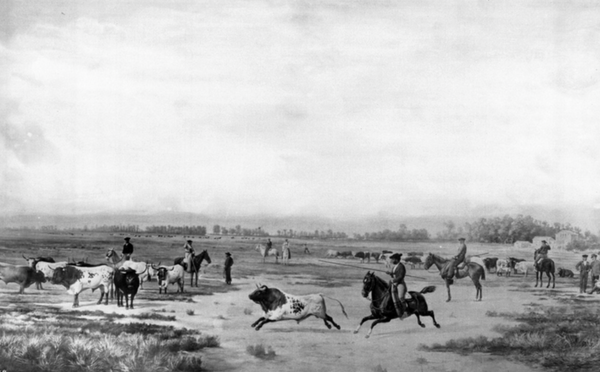
Photo Credit: MLK Library/SJSU Special Collections
Throughout California during the 1850s, white Americans settled on property owned by Californio ranchers. They built homes, planted crops, and raised livestock on land that belonged to someone else. Although these "squatters" had no legal title, lease, right, or claim to the property, they continued to occupy the land as if it were their own.
The squatters' illegal possession of the land appeared to be in direct violation of Title VIII of the Treaty of Guadalupe Hidalgo, which stated, "Mexicans now established in territories previously belonging to México . . . shall be free to continue . . . retaining the property which they possess in the said territories" (italics added). Title VIII came under attack in Washington, D.C., almost immediately. Less than six months after California gained statehood, California Senator William M. Gwin introduced a bill in Congress known as the California Land Act of 1851.
On the surface, the purpose of the California Land Act of 1851 was to resolve private property claims arising from American squatters occupying land owned by Mexican Californios. Rather than creating a law that made squatting illegal, the Act required the landowner, not the squatter, to file a claim with a three-person Public Land Commission appointed by the President of the United States. The law was, without question, a strategy for the United States to populate the valuable California landscape with people of the United States to fulfill economic goals that were the objectives of President Polk's decision to wage war with México.
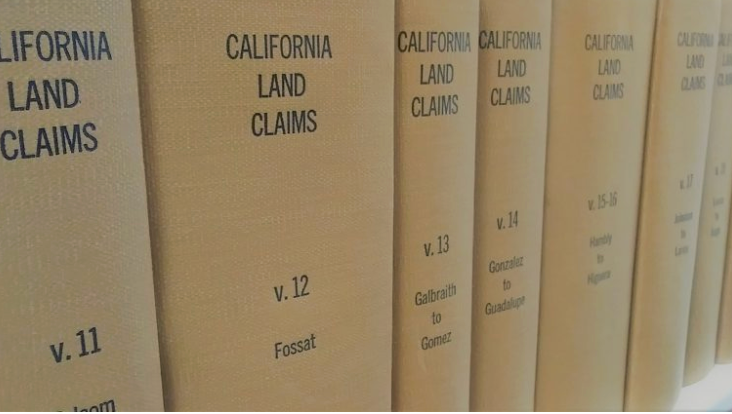
Despite the language in Title VIII of the Treaty of Guadalupe Hidalgo, Antonio Chaboya's Rancho Yerba Buena would fall prey to American swindlers. A year after President Millard Fillmore signed the California Land Act into law on March 3, 1851, Chaboya dutifully filed a claim of ownership of Rancho Yerba Buena with the Public Land Commission on March 18, 1852.
After years of filings, hearings, and enormous legal expenses, the Public Land Commission granted a land patent to Chaboya for his rancho in 1859. During those seven years, he gradually whittled away the 24,342 acres he owned to pay for attorneys and to avoid further legal expenses by selling land to squatters. Like his fellow Californio ranchers, Chaboya measured wealth in acreage, not cash. His hides and tallow were his currency to acquire material goods for his opulent estate. He had to trade parcels of his land to pay for legal representation. By the time he paid all legal expenses and sold land to squatters, his family inherited about 2,200 acres upon his death in 1865.
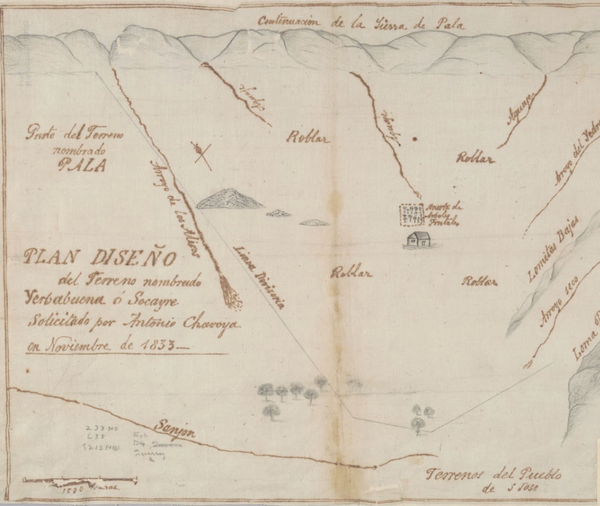
Photo Credit: U.C. Berkeley
This sad episode in San José's history, a classic example of structural racism as defined by the Aspen Institute, was repeated throughout California during the latter part of the 1800s. The Aspen Institute, a global nonprofit think tank "committed to realizing a free, just, and equitable society," defines structural racism as: "A system in which public policies, institutional practices, cultural representations, and other norms work in various, often reinforcing ways to perpetuate racial group inequity."
Pre-21st-century local chroniclers of San José's past did not examine the Antonio Chaboya story, leaving out a vital watershed moment from the city's history. By the time the United States admitted California as a sovereign American state, the largest landowner in San José was a Mexican man born in the valley. Through public policy and cultural misrepresentation, Americans attempted to prevent Mexicans from prospering from the abundant natural resources in the area. With resilience and perseverance, however, ethnic Mexicans overcame structural racism to continue making meaningful contributions to San José's growth and development.
Get the Book
Mexican Heritage Plaza: A Symbol of Resilience and Perseverance by Eddie García is available in paperback and on Kindle.
Purchase on Amazon: amazon.com — Mexican Heritage Plaza
Stories like this don't tell themselves.
SVL has spent over a decade making the invisible visible — celebrating Latino excellence, naming hard truths, and calling our comunidad to action. Independent Latino journalism only survives when the community it serves decides it's worth protecting.
There are two ways to stand with us:
Are you a Latino professional, entrepreneur, or leader ready to be celebrated? Become a Cultura Ambassador — SVL's official community membership for Latino leaders who are ready to have their story told, their work amplified, and their excellence made visible.
Cultura Ambassador: svlatino.com/collections/join-our-tribe
Want to support our mission? Become an Amigo de SVL. Your support keeps our journalism independent, our stories free, and our #CreoEnTi programs and community events alive. No spotlight required. Just solidarity.
Amigo de SVL: svlatino.com/collections/join-our-tribe/products/amigo-de-svl
Juntos Adelante. Because silence is complicity. And so is inaction.
#JuntosAdelante #CreoEnTi #WeAreSVL #SVLVoices #LatinoHeritage #Raíces #CreoEnNosotros #SilenceIsComplicity